Data Lakehouse vs Data Warehouse vs Data Lake: What's the Difference?

A data warehouse is a proprietary, structured, SQL-first analytical database: you load cleaned, modeled data into it and get fast, governed BI queries out. A data lake is cheap, open storage — typically cloud object stores holding raw files of any shape, from CSVs to images — that scales practically without limit but offers few database guarantees. A data lakehouse is the data lake upgraded with database capabilities — ACID transactions, upserts and deletes, indexing, schema enforcement — so that one copy of data on open storage can serve BI, machine learning, and streaming workloads alike.
Which one you should build on depends on what your data looks like, who queries it, and how much you value keeping your storage open. If all you need is dashboards over modest volumes of structured data, a warehouse remains the path of least resistance. If you are juggling large volumes, unstructured data, machine learning, streaming ingestion, or multiple query engines, the calculus shifts quickly toward a lakehouse. The rest of this post walks through each architecture honestly — strengths and costs — and ends with a side-by-side table and concrete guidance on choosing.
The Data Warehouse: Fast, Governed, and Proprietary
Data warehouses have been the workhorse of analytics for decades, from on-premise appliances like Teradata to cloud-native services like Snowflake, Google BigQuery, and Amazon Redshift. The model is simple: extract data from operational systems, transform it into well-defined relational schemas, and load it into a system purpose-built for analytical SQL.
The strengths are real and should not be understated:
- Query performance. Warehouses control the full stack — storage layout, statistics, caching, query optimization — and are ruthlessly tuned for low-latency SQL. For interactive BI dashboards over structured data, they set the bar.
- Governance and management. Mature access controls, auditing, data masking, and workload management come built in. Schemas are enforced on write, so the data inside a warehouse tends to be clean by construction.
- Simplicity. A cloud warehouse is a single managed product. There is one system to secure, one SQL dialect to learn, one vendor to call.
The costs show up as the footprint grows:
- Lock-in. Warehouse storage formats are proprietary. Your data lives inside the vendor's system, readable only through the vendor's compute. Migrating out — or even letting a second engine read the same tables — means exporting and copying.
- ELT copies. Because the warehouse only speaks structured SQL, data must be copied into it, and often copied again into marts and extracts for different teams. Each copy adds pipeline complexity, staleness, and cost.
- Price at scale. Coupled compute and proprietary storage are priced at a premium. At tens or hundreds of terabytes with heavy transformation workloads, warehouse bills routinely become one of the largest line items in a data platform budget.
- Poor fit for ML and unstructured data. Training a model on images, logs, or raw event streams inside a warehouse ranges from awkward to impossible. Data science teams typically end up exporting data back out — another copy.
The Data Lake: Cheap, Open, and Unreliable
Data lakes emerged from the Hadoop era and matured on cloud object storage — Amazon S3, Google Cloud Storage, Azure Data Lake Storage. The idea inverts the warehouse: instead of modeling data before loading it, land everything raw and cheap, and decide the schema when you read it.
The strengths:
- Cost. Object storage costs a small fraction of warehouse storage, with durability and availability handled by the cloud provider. Storage and compute scale independently — you pay for queries only when you run them.
- Openness. Data sits in open file formats like Apache Parquet and Apache ORC. Any engine — Apache Spark, Apache Flink, Trino, Presto, Ray, or a Python script — can read the same files. There is no vendor gatekeeping access to your own data.
- Any data shape. Structured tables, semi-structured JSON, free text, images, audio, model checkpoints — a lake stores all of it, which is exactly why ML and data science teams gravitate to lakes.
The weaknesses are equally well documented:
- No transactions. A plain data lake is just files in directories. A failed job can leave partial writes visible to readers; two concurrent writers can corrupt each other. There is no atomic commit, no isolation, no rollback.
- No upserts or deletes. Object stores are append-oriented. Updating a single record — say, for a GDPR deletion request or a late-arriving correction — traditionally meant rewriting entire partitions.
- Data swamps. Without schema enforcement, quality controls, or table-level metadata, lakes decay into "data swamps": directories of files nobody trusts and nobody dares delete.
- Slow BI. Query engines scanning raw files lack the indexes, statistics, and optimized layouts a warehouse maintains, so interactive dashboard performance over a plain lake generally disappoints.
The Data Lakehouse: The Lake, Upgraded to a Database
The lakehouse closes the gap between the two by adding a transactional metadata layer — an open table format — on top of the open files already sitting in the lake. Projects like Apache Hudi, Apache Iceberg, and Delta Lake define tables (not just files) over Parquet and ORC, and bring the database capabilities the lake was missing:
- ACID transactions with concurrency control, so writers commit atomically and readers never see partial results.
- Upserts and deletes, made efficient by indexing mechanisms that locate the records to change without rewriting whole partitions — the capability that first motivated Hudi's creation at Uber.
- Schema enforcement and evolution, so tables reject malformed writes and can add or change columns without full rewrites.
- Performance features — indexing, statistics, clustering, compaction, time travel — that let query engines approach warehouse-class performance on lake storage.
Two properties follow that neither predecessor offers. First, unified batch and streaming: because the table layer supports fast upserts and incremental pulls, the same table can be written by a streaming pipeline and read by both a dashboard and a nightly batch job, eliminating the classic lambda-architecture split. Second, one copy of data, many engines: the table is defined in an open format on open storage, so Spark, Flink, Trino, Presto, StarRocks, Daft, and warehouse engines with external-table support can all query the same physical bytes. No ELT copy into a proprietary system, no extract back out for ML.
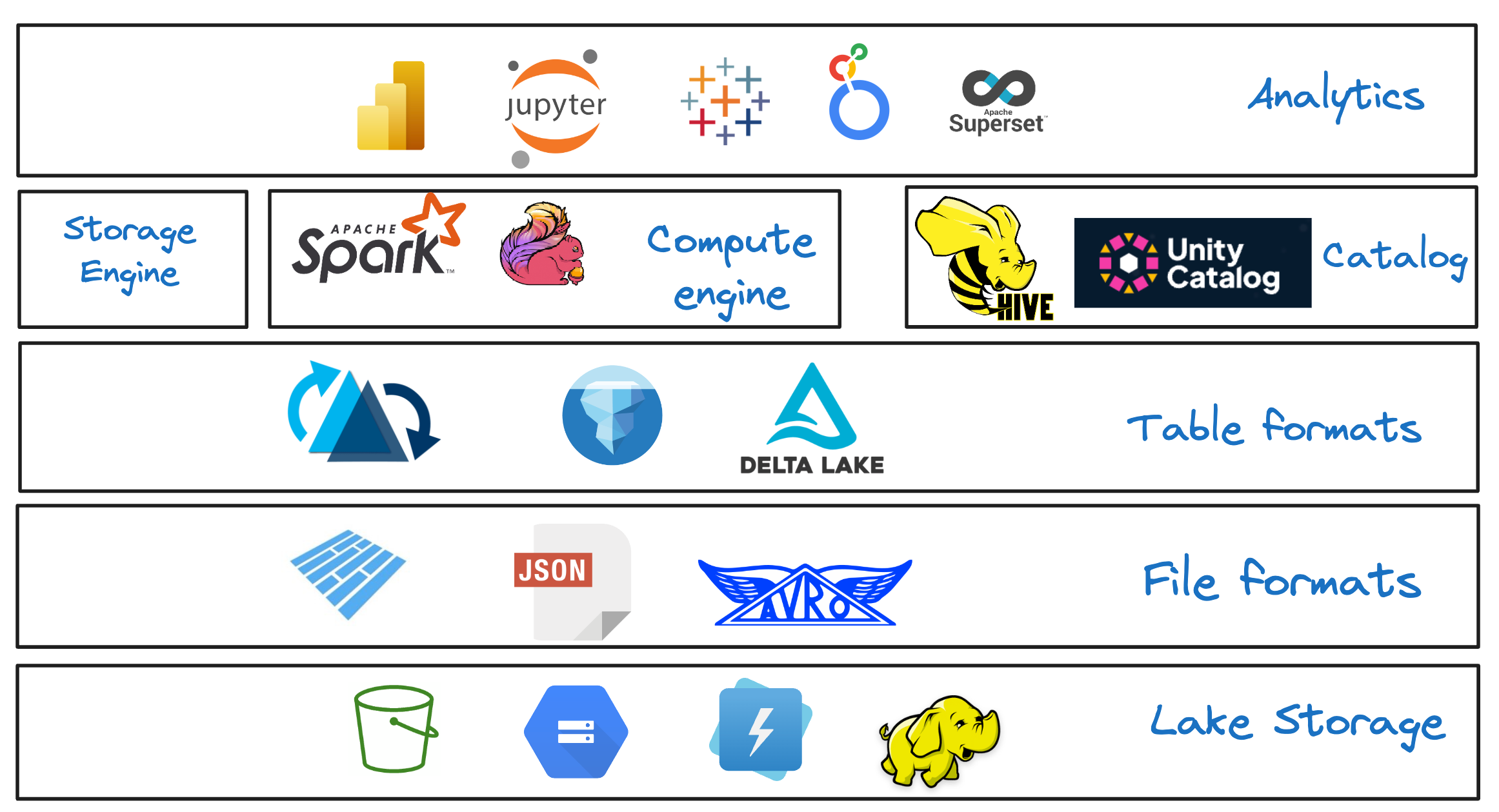
Figure: Data Lakehouse Architecture — open table formats and a storage engine layered over cloud object storage, serving multiple compute engines
For a deeper treatment of the architecture itself — the storage, file-format, table-format, catalog, and compute layers — see What is a Data Lakehouse & How does it Work?
The honest caveat: a lakehouse is assembled from components rather than bought as one product, so it demands more engineering judgment than swiping a credit card at a warehouse vendor. Managed lakehouse platforms narrow that gap, but the trade-off between operational simplicity and openness has not disappeared entirely.
Side-by-Side Comparison
| Dimension | Data Warehouse | Data Lake | Data Lakehouse |
|---|---|---|---|
| Storage cost | High — proprietary storage at premium pricing | Low — commodity cloud object storage | Low — same object storage as the lake |
| Data types | Structured (some semi-structured support) | Structured, semi-structured, unstructured | Structured, semi-structured, unstructured |
| Transactions | Full ACID | None | ACID via table formats (Hudi, Iceberg, Delta Lake) |
| Updates / deletes | Native SQL DML | Rewrite files manually | Native upserts and deletes, index-accelerated |
| Query performance | Excellent for SQL/BI | Poor to moderate (raw file scans) | Good to excellent with indexing, clustering, compaction |
| Openness / lock-in | Proprietary format, single vendor engine | Fully open files, any engine | Open table formats, any engine |
| Streaming support | Micro-batch loading, often at extra cost | Append-only file drops | Native streaming ingestion with incremental processing |
| ML support | Weak — data must be exported | Strong — raw data access for any framework | Strong — same open data, plus reliable managed tables |
| Governance / quality | Mature, built in | Do-it-yourself, frequently neglected | Schema enforcement, time travel, auditing via table layer |
| Typical tools | Snowflake, BigQuery, Redshift | S3 / GCS / ADLS + Spark, Presto | Hudi / Iceberg / Delta Lake + Spark, Flink, Trino, StarRocks |
When Is Each the Right Choice?
Choose a data warehouse when your data is modest in volume, almost entirely structured, and your consumers are BI analysts writing SQL. A small team running dashboards over a few terabytes will likely ship faster and operate more cheaply on a managed warehouse than by assembling a lakehouse stack. Lock-in is a real cost, but at small scale it may be a cost worth paying for simplicity.
Choose a plain data lake when you primarily need a cheap landing zone and archive — raw event dumps, ML training corpora, cold retention — and you do not need transactional tables or fast SQL over that data. Many lakehouses begin life as exactly this.
Choose a lakehouse when one or more of these is true: data volumes are growing into the tens of terabytes and beyond and warehouse bills sting; you need machine learning and BI on the same data; you ingest streaming or frequently-updated data (CDC from operational databases is the canonical case); you need record-level updates and deletes for compliance; or you want multiple engines — and the freedom to change vendors — over a single copy of data. These are the workloads the architecture was built for; see the Hudi use cases for concrete patterns.
The choice is also not exclusive. A common and pragmatic pattern is a lakehouse as the system of record with a warehouse serving a subset of curated, high-concurrency dashboards — increasingly by querying the lakehouse tables in place rather than holding a copy.
The Convergence Trend
The sharp lines between these categories are blurring, and they are blurring toward the lakehouse. Warehouses are opening up: Snowflake, BigQuery, and Redshift all now query and, in varying degrees, write open table formats on customer-owned object storage, an acknowledgment that customers refuse to keep their primary copy of data in a proprietary format. Meanwhile, lakes are getting more database-like: table formats keep absorbing capabilities that were once warehouse differentiators — multi-modal indexing, materialized-view-style pre-computation, richer catalogs and governance — while interoperability projects like Apache XTable let one physical table be exposed in multiple table formats at once.
Follow both trends to their end point and you arrive at the same place: open data on cheap storage, database-grade table management in an open layer above it, and interchangeable compute engines on top. That meeting point is the lakehouse. The remaining competition is less about whether to structure data this way and more about which table formats, catalogs, and engines earn a place in the stack.
Conclusion
Warehouses deliver performance and governance at the price of lock-in and copies; lakes deliver cost and openness at the price of reliability; the lakehouse keeps the lake's economics and openness while restoring the database guarantees — transactions, upserts, indexing, schema management — that make data trustworthy and fast to query. For small, purely structured BI workloads, a warehouse is still a fine and simple answer. For everything pushing past that — scale, streaming, ML, multiple engines, or simply the desire to own your data in an open format — the lakehouse is where both the technology and the industry are heading. Apache Hudi's approach to this is a full transactional database layer for the lake, and the use cases it serves in production are the clearest evidence that the gap between lake and warehouse has effectively closed.
FAQ
Is a lakehouse cheaper than a warehouse?
Usually, at scale. A lakehouse stores data on commodity cloud object storage, which costs a small fraction of proprietary warehouse storage, and it avoids maintaining multiple ELT copies of the same data. At small volumes the difference narrows, and a managed warehouse can be cheaper in engineering time, so total cost depends on scale and team.
Can a lakehouse replace a data warehouse?
For many organizations, yes. Open table formats bring transactions, upserts, indexing, and schema management to lake storage, and engines like Trino, StarRocks, and Spark deliver strong SQL performance on those tables. Some teams still keep a warehouse for very high-concurrency, low-latency dashboards, often querying the lakehouse tables directly instead of holding a separate copy.
Is Snowflake a data lakehouse?
Snowflake is a cloud data warehouse at its core, storing data in a proprietary format managed by its own engine. It has added lakehouse-style capabilities, notably support for Apache Iceberg tables on customer-owned object storage. Whether a Snowflake deployment qualifies as a lakehouse depends on whether the primary data copy lives in an open format that other engines can access.
What is the main difference between a data lake and a data lakehouse?
A data lake is raw files on cheap object storage with no database guarantees, while a lakehouse adds an open table format layer, such as Apache Hudi, Apache Iceberg, or Delta Lake, on top of those files. That layer provides ACID transactions, record-level updates and deletes, indexing, and schema enforcement, turning unreliable file collections into managed tables.
Do I need Hadoop to build a data lake or lakehouse?
No. Modern lakes and lakehouses are built on cloud object stores like Amazon S3, Google Cloud Storage, or Azure Data Lake Storage, with engines such as Apache Spark, Apache Flink, and Trino running against them. Hadoop HDFS is still supported by these tools but is no longer required or typical for new deployments.
Which lakehouse table format should I choose?
Apache Hudi, Apache Iceberg, and Delta Lake all provide ACID transactions and schema evolution on open storage, and all are production-proven. Hudi stands out for update-heavy and streaming workloads thanks to its indexing and incremental processing, while the best fit overall depends on your engines, workloads, and ecosystem. Interoperability tools like Apache XTable also let one table be read in multiple formats.